Stump grinding
A removal leaves the root ball and a cut stump. Grinding below grade while we are already on site is the cheapest time to deal with it.
Licensed and insured removals, including trees over roofs, inside tight subdivision lots, and close to power lines. Stump grinding available on the same visit and every piece of debris leaves with us.
Call or text anytime. If we miss you, we’ll call you right back.
Tell us about the tree and we will schedule a look at it. No charge for the estimate.
Pooler has grown fast, and a lot of that growth happened underneath trees that were already full grown. Builders left mature pines and oaks standing on lots that are now a fraction of the acreage those trees started on. That is the job here. Not felling timber in an open field, but taking a large tree apart in a space that has a roof on one side and a fence on the other.
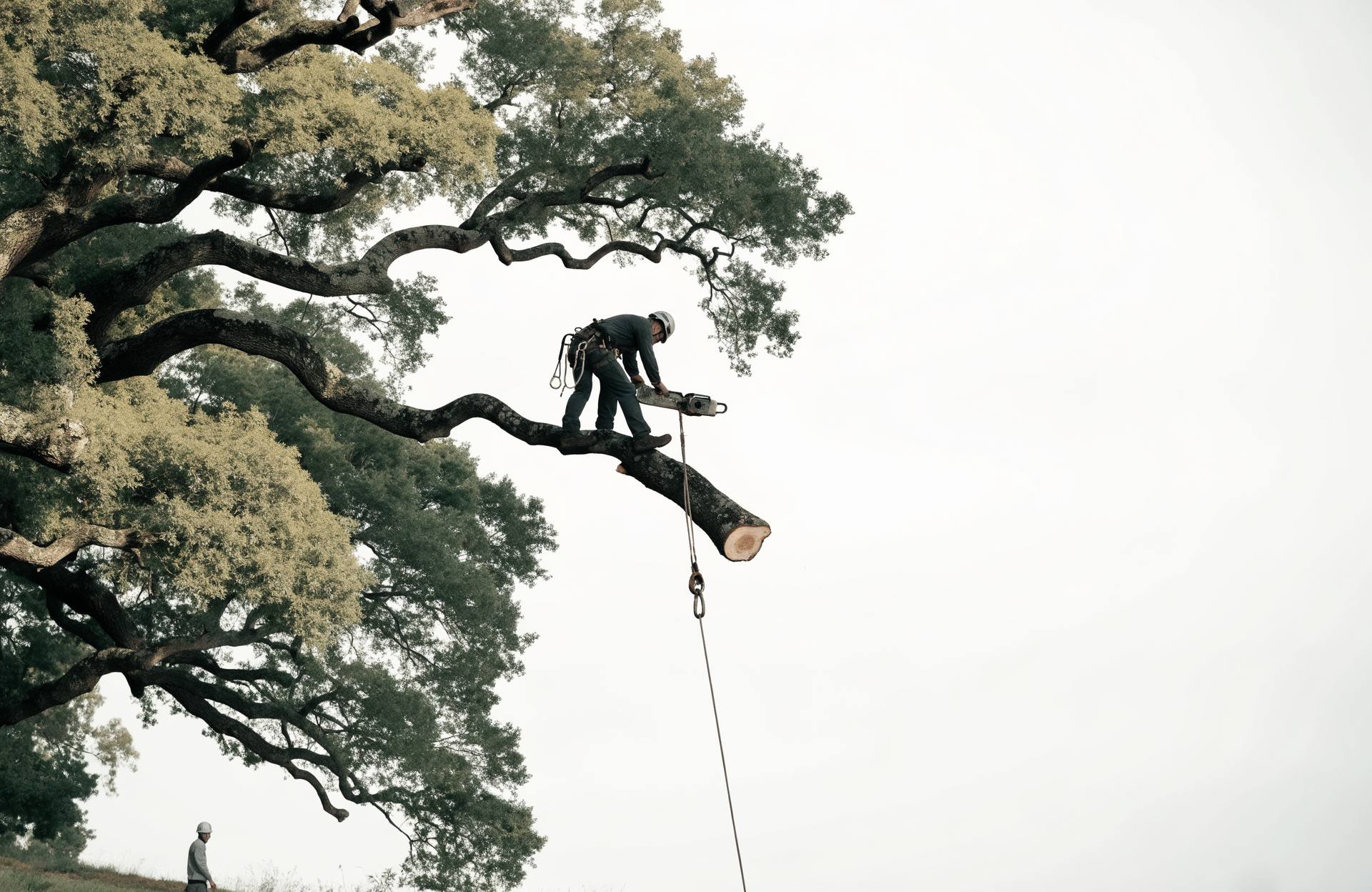
We handle tree removal in Pooler and across western Chatham County for homeowners, property managers, and builders. Most of what we take down is within a rope length of something expensive, so the work is done from a climbing line or a bucket, in sections, lowered under control rather than dropped. When there is genuine room to fell a tree in one piece we will do that, because it is faster and it costs you less. The point is that access decides the method, and we quote the method we actually intend to use.
Every removal we quote includes hauling the wood and brush off your property and cleaning up the work area. If you want the stump gone too, stump grinding is quoted as its own line so you can decide, and it is far cheaper to do while our equipment is already in your yard. If the tree is already down, or leaning on the house right now, that is emergency tree removal and it jumps ahead of scheduled work.
Not every ugly tree is a hazard, and not every healthy-looking tree is safe. A few patterns show up over and over on the coastal plain:
If you are not sure which category yours falls into, that is exactly what the free on-site estimate is for. We will tell you if a tree can be saved with tree trimming instead, because selling you a removal you did not need is a bad way to get referred to your neighbor.
Anyone quoting a firm price over the phone without seeing the tree is guessing. Five things move the number, and they move it a lot:
We put all of this in writing before any work starts, with the stump priced separately so you can see what you are paying for. The estimate itself is free and there is no obligation attached to it.
Pooler and Chatham County both regulate tree removal, and the rules are keyed to things like species and trunk diameter. Live oaks in particular get more scrutiny than a volunteer pine, and requirements are tighter on commercial and newly developed parcels than on an established residential yard. We check what applies to your specific tree and address before the saw comes out, and we handle the paperwork where one is required. You should not be the one discovering an ordinance after the tree is on the ground.
The sequence below is what a typical removal near a structure looks like. An open-lot removal skips several of these steps, which is part of why it costs less.
Southern live oak, loblolly and slash pine, water oak, laurel oak, sweetgum, pecan, and southern magnolia make up most of the residential work here, with bald cypress on the wetter parcels toward the Savannah River. Species matters more than people expect. Live oak has heavy, dense limbs that reach out laterally rather than up, so a single limb can outweigh a whole small tree and has to be rigged in short pieces. Pines are tall and comparatively light but they have very little taper, which changes how the spar is sectioned. Sweetgum and water oak are more likely to have internal decay that is invisible until the first cut opens it up, which is why we reassess as we go rather than committing to one plan from the ground.
Hurricane season runs June through November on this coast, and tropical systems have a long track record of putting trees into Pooler houses. Storm work is different from planned removal. The tree is often already under load, bent or pinned in a way that stores energy, and cutting it in the wrong order releases that energy somewhere unpredictable. We photograph the damage before touching anything, because that is the documentation your adjuster will want, then relieve the load in a controlled sequence. For debris fields, split trunks, and limb piles left behind after the system passes, see storm damage cleanup.
A removal leaves the root ball and a cut stump. Grinding below grade while we are already on site is the cheapest time to deal with it.
A tree on the house, the car, or across the drive. Storm work takes priority over scheduled jobs and we document it for your insurer.
Often the alternative to removal. Clearing limbs off the roof or thinning a canopy before hurricane season can keep a healthy tree standing.
Downed limbs, split trunks, and debris piles cleared and hauled off after a tropical system moves through.
Most single-tree residential removals are a one-day job, and a straightforward one in an open yard can be a half day. What stretches it out is access rather than size. Carrying everything through a gate to a backyard, working around a pool, or rigging every piece over a roof can turn a large tree into a two-day job. We will tell you which one yours is when we quote it, so you can plan around the driveway being occupied.
Usually, and it is a common question in the newer neighborhoods off Pooler Parkway where the houses sit close together. Standard gate access is about three feet, which rules out a full-size chipper in the backyard, so we work off a climbing line and carry or winch material out to the street. Where a lot genuinely cannot be reached from the ground, a crane pick from the road is sometimes the cheaper answer despite the equipment cost, because it turns two days of rigging into a few hours.
It stays, and it does not rot away quickly. A hardwood stump in our climate can sit for years, and oaks and sweetgums frequently send up suckers from the remaining root system that you will be cutting back repeatedly. Stumps also settle unevenly, which is a problem if you plan to sod, replant, or run a mower over the spot. Grinding while we are on site costs less than bringing the machine back as a separate trip. See stump grinding for what that involves.
Generally it depends on whether the tree hit something. Most policies cover removal when a fallen tree has damaged a covered structure such as the house, the garage, or a fence, and many will not cover taking down a standing tree just because it is dead or you consider it a risk. A tree that falls in the yard and hits nothing often is not covered either. Deductibles and per-tree caps vary a lot, so check your specific policy. We photograph everything before we start, which is what an adjuster will ask you for.
If the trunk straddles the line it is generally considered jointly owned in Georgia, and taking it down is a decision both property owners need to agree to. If the trunk is entirely on your side, it is your tree even when the canopy reaches over the neighbor's yard. Either way, if we need to drop limbs across a boundary or set the chipper in a neighbor's driveway, we ask them first. That conversation is much easier before the crew shows up than during.
Winter is easier work for hardwoods. The leaves are off, so there is less material to chip and the crew can actually see the structure of the tree before climbing it. Ground conditions are usually firmer too, which matters for getting equipment across a lawn without leaving ruts. That said, a hazardous tree should not wait for a season, and hurricane season is exactly when a compromised tree is most likely to come down on its own. Pines can be taken any time of year.
Send the details on the tree and we will come look at it in person. Licensed, insured, and the debris leaves with us.
Call or text anytime. If we miss you, we’ll call you right back.